
NSW Police Search Powers - Case of R v Nguyen [2025] NSWDC 567

It is about 10pm. You turn into a motel car park off the Hume Highway. An unmarked police car follows you in, and within minutes an officer is telling you he is going to search you and your car because "you've got a history with drugs".
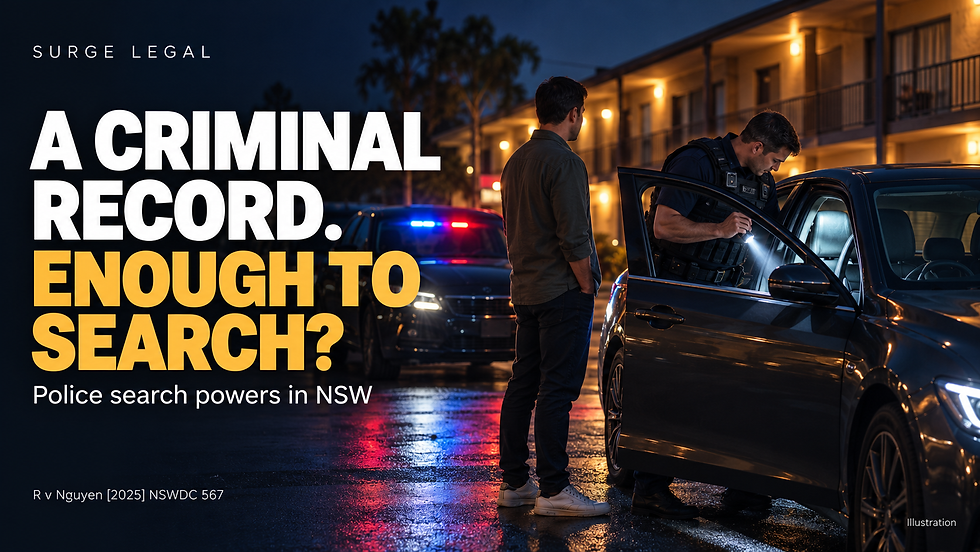
Can police do that? In R v Nguyen [2025] NSWDC 567, decided on 4 November 2025, Wass SC DCJ of the NSW District Court said no. The judge found the search was unlawful and excluded the evidence it produced: the drugs found in the car and the contents of the accused's phone.
This was a ruling on the admissibility of evidence before trial, made by a single judge on the facts of one case. It is not binding on other courts. But it is a clear and recent statement of the limits on police search powers in NSW, and of what can happen when those limits are ignored.
What happened
On the night of 28 August 2023, two officers from a proactive crime unit were patrolling in an unmarked car. At about 10 pm on the Hume Highway at Bass Hill, they saw a Honda with Queensland plates make an illegal U-turn at the lights and then turn almost immediately into a motel driveway.
Police had one recent piece of intelligence about the motel: a woman and a man were said to be supplying drugs from one particular room. The intelligence had nothing to do with the accused, his car, or that room. The police followed the Honda into the car park anyway.
Once there, one officer approached the accused, who identified himself with his licence and was cooperative throughout. He was not either of the people named in the intelligence. Checks showed he was on parole. The search began at 10.09pm.
On body-worn video, the officer gave his reason for searching: "You've got a history with drugs… and you've obviously come into this hotel, which is really well known for drugs" .
Police found about 57 grams of methylamphetamine and 3.2 grams of heroin in the car, and messages on the phone he had with him led to four further supply charges. The accused applied before trial to have all of that evidence excluded.
The explanations that came later
At the hearing, the officers gave further reasons for the search. They said they had seen the accused "fidgeting" in the car, and that a woman had walked up to the car window.
The judge did not accept those explanations:
The "fidgeting". The police car was at least 15 metres away, and the claimed observation was below the steering wheel. The judge said that evidence "beggared belief" .
The woman at the window. Before the search, police had already checked her and she came back "nil adverse". The officer had excluded her as someone involved in any drug deal.
The motel. There was no information that the motel was "really well known for drugs", only that two people were dealing from one unit.
The officer also agreed that the traffic offence, the intelligence and the accused's criminal history would not be enough on their own to give him a reasonable suspicion.
The judge described the later reasons as "an ex post facto attempt by both officers to justify what was an arbitrary exercise of power to search … based only on the accused's history". The search was a "random crime stop" .
The law: what police need before they search you
Under the Law Enforcement (Powers and Responsibilities) Act 2002 (NSW) (LEPRA), police can stop and search a person (s 21) or a vehicle (s 36) without a warrant if they suspect on reasonable grounds that, for example, the person or vehicle has prohibited drugs.
The judge summarised what "reasonable suspicion" means:
It is less than a reasonable belief, but more than a possibility.
It is not arbitrary. There must be some factual basis for it.
The Court asks two questions. First, what grounds did the officer actually rely on at the time? Second, viewed objectively, were those grounds reasonable? The focus is on the grounds actually relied on at the time. In this case, reasons the officers put forward later did not save the search.
Is a criminal record enough?
Ordinarily, no. The judge accepted that Parliament could not have intended that knowing about someone's criminal record would, on its own, allow police to stop, detain and search that person at any time. The judge referred to another District Court decision, Reyes-Carrion v State of New South Wales [2025] NSWDC 28, which said that ordinarily a record or intelligence on its own will not be enough, although each case turns on its facts.
The judge put it plainly: "A person who has committed prior offences and is in the community on bail or on parole, is entitled to the same protections under LEPRA as any other member of the community. When it comes to them being searched by police, LEPRA applies equally to all" .
Why the evidence was thrown out
Unlawfully obtained evidence is not automatically excluded. Under s 138 of the Evidence Act 1995 (NSW), once the accused shows the evidence was obtained illegally or improperly, it is up to the prosecution to persuade the Court that the desirability of admitting it outweighs the undesirability of admitting evidence obtained that way.
Some factors pointed towards admitting the evidence. The judge accepted that its probative value was high and that "Without it, the Crown has no case". The charges were also serious, each carrying a maximum of 15 years' imprisonment.
But other factors weighed heavily the other way:
The seriousness of the breach. The officers' actions were "highly reckless, if not deliberate", and the search was "a clear example of an abuse of search power" [102]. It was "not a minor contravention".
The right to move freely. People should be free to go to a hotel or motel at 10pm "without being targeted in this way". The fact that police turned out to be right "is no answer".
Lawful options were available. Police could have watched and waited or sought a warrant. Instead, in the judge's words, "they were engaged in lazy policing, made unreasonable assumptions, and cut corners".
The public interest. Despite "repeated denunciation by the Courts" of searching without reasonable suspicion, the officers went ahead. "There is a strong public interest in calling for strict compliance" .
The Crown did not persuade the Court, and the evidence of the car search and the phone contents was excluded.
What this case means for you
This decision does not condone the use or possession of drugs and does not give you a license to possess or use drugs in your car, refuse a police search, or assume that evidence will always be excluded if something goes wrong. This is not the point of this case.
Section 138 involves a balancing exercise, and the outcome depends on the facts. But it does show that the courts take police search powers seriously. Here are some practical points.
1. Stay calm and do not physically resist. If police say they are going to search you or your car, do not obstruct them. Whether the search was lawful is something your lawyer can challenge later in court.
2. Ask why. When police exercise a search power, LEPRA's safeguards generally require them to tell you the reason. In this case, the reason given on camera became the key evidence.
3. Remember what was said. Write down what happened as soon as you can: the time, where police were parked, what they said and what reasons they gave. Body-worn video, CCTV and the officers' notes can all become important. In Nguyen, there were no notebook entries, and no one obtained CCTV footage [10].
4. You do not have to explain yourself. Apart from limited obligations, such as giving your name and address in some circumstances or showing your licence when you are driving, you generally have the right to remain silent. It is usually wise to get legal advice before answering questions.
5. Think about your phone. If police take your phone, the rules for accessing it are separate. Read our guide to what police can and can't do with your phone.
6. Get advice early. Challenges to the legality of a search are usually raised before trial. Your lawyer will look at the police facts sheet, statements and body-worn video to see whether the grounds police relied on stand up.
How Surge Legal can help
If you have been charged after a police search, how that search was carried out could matter a great deal. Our criminal law team can review the evidence, including body-worn footage and police statements, and advise whether there are grounds to challenge the search or seek to exclude evidence.
Call (02) 8551 7851 or email info@surgelegal.com.au to book a free 20-minute consultation, from our Parramatta and Lindfield offices.
This article is a general summary of R v Nguyen [2025] NSWDC 567 for information purposes only. It does not constitute legal advice. Please contact Surge Legal to discuss your individual circumstances.


